

Cornstarch alone won’t work—you need to pair it with cream of tartar and baking soda for actual lift. Mix 1/2 teaspoon cream of tartar, 1/4 teaspoon baking soda, and 1/4 teaspoon cornstarch to replace one teaspoon of baking powder. The cornstarch absorbs moisture while the acid and base create those CO2 bubbles.
Just remember: reduce your liquid by 1–2 tablespoons per teaspoon swapped, and test a single muffin first to nail the texture before committing to your full batch.
Why Swap Baking Powder for Cornstarch?
Why would anyone want to replace baking powder with cornstarch? I’ll be honest—you probably shouldn’t, at least not completely. Here’s the thing: baking powder makes your baked goods rise and become fluffy, while cornstarch doesn’t do that at all. If you swap them one-to-one, you’re looking at dense, flat results. That said, I understand the appeal. Maybe you’re avoiding certain baking powder ingredients, or you’re curious about texture modifications. Cornstarch can work as a drying agent in homemade baking powder blends, but it won’t replace baking powder’s leavening power alone. Think of it this way: cornstarch changes how your batter behaves, not whether it rises. If you’re exploring alternatives, I’d suggest using cornstarch alongside other leaveners instead.
What Baking Powder Actually Does as a Leavening Agent
Before you can swap cornstarch for baking powder, you need to understand what baking powder actually does—it creates a chemical reaction between an acid and a base that releases carbon dioxide gas, which makes your batter rise. That CO2 forms tiny bubbles throughout your mixture, and when heat hits those bubbles during baking, they expand even more, giving you that light, fluffy texture. So when you’re thinking about substitutions, you’re really trying to replace that leavening action, not just add bulk to your recipe.
Chemical Reaction Process
Baking powder works through a straightforward chemical reaction that happens in two stages. When you mix baking powder into your wet ingredients, moisture triggers the first phase immediately. The bicarbonate (that’s baking soda) reacts with an acid—usually cream of tartar or another acid-salt reaction partner—and carbon dioxide gas forms right away. Those tiny CO2 bubbles spread throughout your batter, creating air pockets that make everything lighter and fluffier. Then heat kicks in during baking, sparking the second reaction phase. More gas releases, causing your batter to rise even further in the oven. Understanding this two-step process helps you appreciate why baking powder is important for achieving that perfect, airy texture.
Rise and Texture Results
So here’s what actually happens to your batter once all that carbon dioxide gets released: those tiny gas bubbles expand and multiply, creating thousands of little air pockets throughout your mixture. This is why baking powder gives you that light, fluffy texture—the CO2 does the heavy lifting.
When you use baking powder, you’re getting two rises. First, the dry acid and base react when wet, creating an immediate lift. Then heat triggers a second rise in the oven. That’s your ticket to airy cakes and tender muffins.
Now here’s the thing: cornstarch doesn’t do any of this. It’s just starch—no leavening power whatsoever. Unlike baking soda or baking powder, cornstarch won’t create those essential air pockets. Your baked goods will be denser, heavier, and honestly, fairly underwhelming.
Can Cornstarch Really Substitute for Baking Powder?
I’ll be straightforward: cornstarch alone won’t give you that fluffy rise you’re after, but it can work in specific situations if you know what you’re doing. The real limitation is that cornstarch just thickens and stabilizes—it doesn’t produce carbon dioxide, so your batter stays flat, and you’ll notice a denser, heavier texture in your final product. Where cornstarch actually shines is when you combine it with acidic or alkaline leaveners, turning it into a helper rather than the main player.
Limitations and Texture Trade-offs
The candid truth? Cornstarch alone won’t give you the rise that baking powder delivers. Here’s what happens when you try:
- Your baked goods won’t rise as much, creating denser results
- The crumb structure changes, giving you a firmer bite instead of that light, fluffy texture
- You’ll lose volume overall, so your cake or cookies shrink
- The final product feels heavier in your mouth
I’ve learned that cornstarch is really a thickener, not a leavening agent. If you’re determined to use it, you’ll need to add baking soda plus an acid like cream of tartar to recreate what baking powder does naturally. Without those additions, you’re fighting an uphill battle. The texture trade-offs are real, and that’s why most of us stick with baking powder.
When Substitution Works Best
Now that you know cornstarch alone won’t cut it, let’s talk about when you can actually make it work. Substitution succeeds best in recipes with existing moisture and acid balance—think chocolate cakes, buttermilk batters, or tangy recipes where that acid can trigger the leavening reaction naturally.
Here’s your approach: replace one teaspoon baking powder with half a teaspoon baking soda plus half a teaspoon cream of tartar. The baking soda and cream of tartar do the heavy lifting; cornstarch stabilizes moisture without pretending to leaven.
| Recipe Type | Best For | Skip It |
|---|---|---|
| Chocolate cakes | Moist batters with acid | Crisp cookies |
| Buttermilk recipes | Tangy ingredients present | Crackers |
| Muffins | Dense, tender crumb | Anything needing rise |
This approach works when you’re already working with acidic ingredients.
The Simple Cornstarch + Cream of Tartar Fix
Want to whip up a homemade baking powder substitute that actually works? This cornstarch and cream of tartar combination is a practical solution when you’re caught without baking powder.
This cornstarch and cream of tartar combination is a practical solution when you’re caught without baking powder.
Here’s what makes this combo tick:
- 1/2 teaspoon cream of tartar acts as your acid component
- 1/4 teaspoon cornstarch absorbs moisture and prevents clumping
- Together they equal 1 teaspoon baking powder
- Scaling’s easy: just multiply both amounts proportionally
Mix these dry ingredients thoroughly right before you bake—don’t wait around. The leavening reaction happens fast, so timing matters. This room-temperature fix works well for last-minute baking emergencies. You’ll get the same lift and rise you’d expect from store-bought baking powder, without any fuss or special equipment.
Mix Your Own Baking Powder (2:1:1 Ratio)
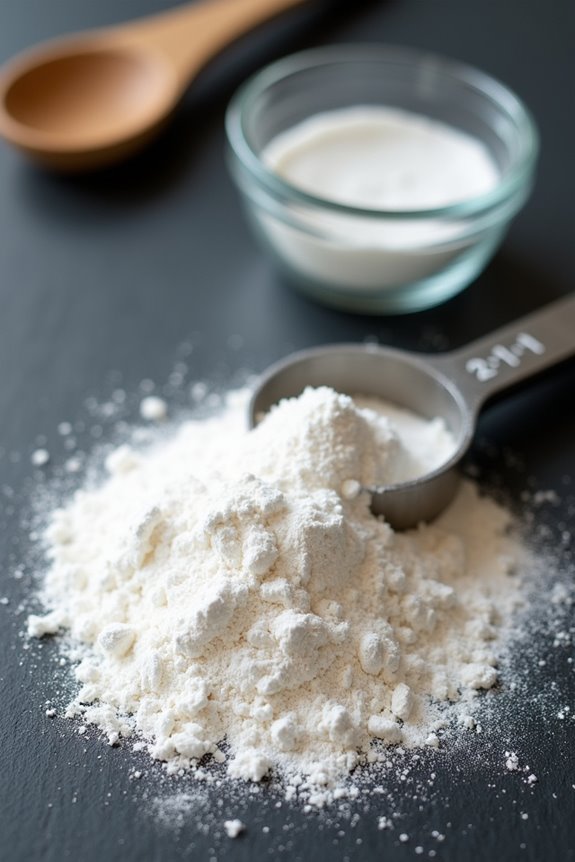
If you’d rather skip the store entirely, you can mix up your own baking powder using just three simple ingredients—and I’m talking about something you probably already have in your kitchen. The formula? A 2:1:1 ratio of cream of tartar, baking soda, and cornstarch. Here’s what happens: cream of tartar provides the acid, baking soda brings the base, and cornstarch prevents clumping while keeping everything dry. Simply combine two parts cream of tartar with one part baking soda and one part cornstarch. One teaspoon of this homemade blend replaces one teaspoon of commercial baking powder perfectly. Store your mixture in an airtight container at room temperature, and you have reliable leavening whenever you need it.
Scaling Ratios and Adjusting Moisture for Cornstarch Blends
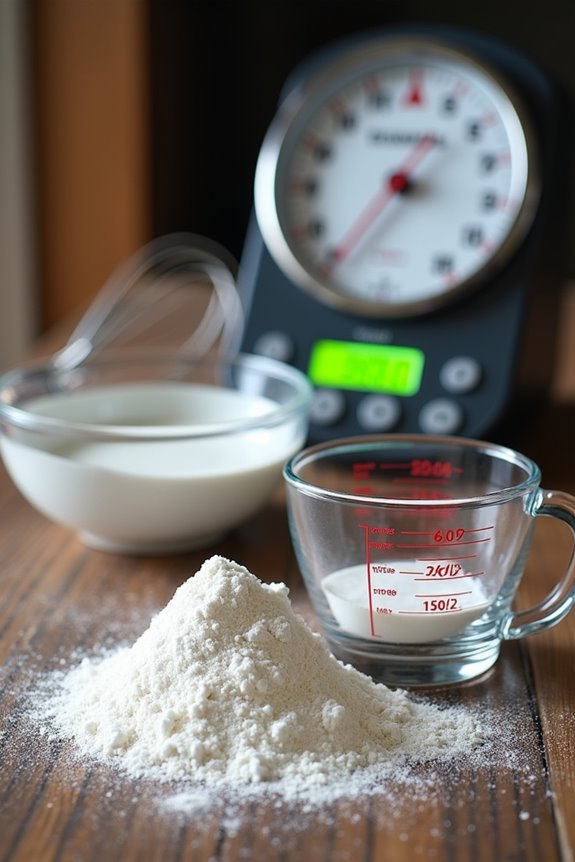
When you’re converting baking powder amounts, I’ve found that scaling up or down from that basic 1/2 teaspoon cornstarch, 1/4 teaspoon baking soda, and 1/4 teaspoon cream of tartar ratio works best—just multiply each ingredient by however many times you need. The tricky part is moisture: since cornstarch thickens your batter, you’ll probably need to add a splash more liquid (like milk or water) to keep things from getting too stiff and dense. I always recommend mixing a small test batch first before committing to your full recipe, because every blend behaves a little differently depending on your ingredients and kitchen conditions.
Cornstarch-to-Baking Powder Conversion
How do you know whether you’re using enough leavening when you swap cornstarch into your baking recipe? I’ll walk you through the conversion so you nail it every time.
To replace 1 teaspoon of baking powder, I combine:
- 1/2 teaspoon cream of tartar
- 1/4 teaspoon baking soda
- 1/4 teaspoon cornstarch
This blend works because cornstarch absorbs moisture while the acid and base create lift. When scaling recipes, multiply all three ingredients proportionally. If your recipe’s heavy on liquids, reduce them slightly—that cornstarch blend adds extra moisture. Mix your leavening into dry ingredients first, then quickly combine everything with wet ingredients. Timing matters here; premature reactions mean flat baked goods.
Adjusting Liquid Content Properly
One thing I’ve learned the hard way: swap cornstarch into your recipe without adjusting the liquid, and you’ll end up with a dense, gluey mess that’d make a hockey puck jealous.
Here’s what I do: for each teaspoon of baking powder I replace, I reduce my liquid by about 1 to 2 tablespoons. Cornstarch absorbs water differently than baking powder does, so this moisture adjustment keeps my batter from becoming too thick or too thin.
I check my batter’s consistency—it should resemble thick pancake batter, not something I’d pour. If I’m using a cornstarch slurry (1 tablespoon cornstarch mixed with 2 tablespoons cold water), I fold it in gradually, watching how the batter responds. This approach gives me better control and prevents over-diluting the mixture.
Testing Blend Ratios First
Testing Blend Ratios First
The best way to nail your cornstarch-to-baking-powder ratio? Test it first in small batches before you go all-in on a full recipe.
Here’s how I approach it:
- Bake a single muffin or cookie using your cornstarch blend to observe rise, crumb structure, and texture
- Start with a 1:3 ratio: one teaspoon baking powder replaced by three teaspoons cornstarch
- Record everything—your ratio, moisture tweaks, and bake time—for future reference
- Add liquid in small increments (a few teaspoons at a time) since cornstarch thickens without creating gas
This testing phase saves you from wasting ingredients on a full batch that doesn’t work. You’ll catch density issues early and adjust accordingly. Once your test bake succeeds, you have a reliable formula to scale up with confidence.
Why Your Cornstarch Cupcakes Came Out Flat (and What to Do About It)
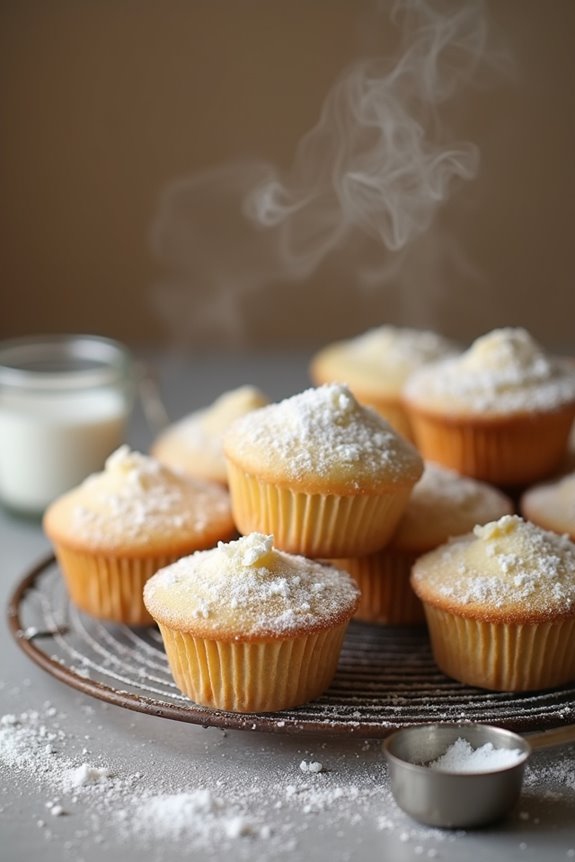
Ever pulled a batch of cornstarch cupcakes from the oven only to find them disappointingly flat and dense?
Ever pulled a batch of cornstarch cupcakes from the oven only to find them disappointingly flat and dense?
I’ve been there. Here’s what happened: cornstarch alone can’t do what baking powder does. See, baking powder contains both an alkaline and a dry acid that create gas bubbles—cornstarch has neither. Without proper leavening, your batter stays heavy and won’t rise.
The fix? Add actual baking powder back in. Use about 1 teaspoon per cup of flour. Alternatively, make your own leavening backup by combining cream of tartar and baking soda.
Also check your mixing technique. Over-mixing develops gluten and deflates those precious air bubbles. Under-mixing leaves lumps that prevent even rising. Bake at the right temperature too—too low, and centers sink.
These adjustments will improve your results.
Cornstarch vs. Baking Soda: Which Substitute Works Better?
Now that we’ve figured out how to rescue flat cupcakes, let’s talk about what actually went wrong in the first place—and it probably comes down to mixing up two ingredients that sound like they might do the same job but absolutely don’t.
Here’s the thing: cornstarch and baking soda (sodium bicarbonate) do completely different jobs. Baking soda creates lift through a chemical reaction with acids, producing carbon dioxide gas. Cornstarch? It just thickens stuff. That’s it.
What this means for your baking:
- Baking soda makes batter rise; cornstarch won’t
- Sodium bicarbonate needs an acid to work properly
- Cornstarch is purely a thickening agent
- Swapping them guarantees flat, dense results
I learned this the hard way, honestly. If your recipe calls for baking soda for leavening, grab baking powder instead—it’s got the acid built in.
Best and Worst Recipes for Cornstarch Substitution
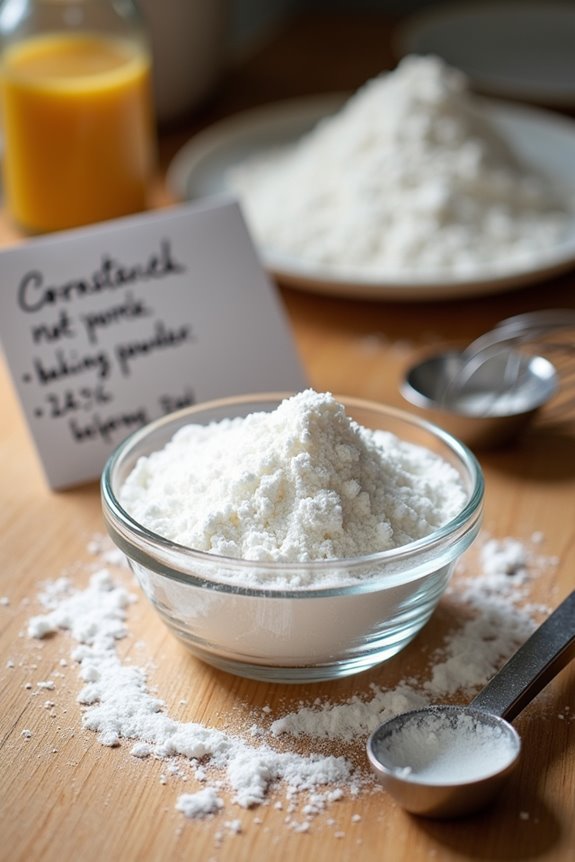
So, which recipes can actually handle a cornstarch swap, and which ones’ll leave you with a disappointing brick of failed baking? I’ve learned that cookies and crackers work well here. These low-moisture recipes benefit from cornstarch because it creates that tender, crispy texture you’re after. Cornstarch works when you don’t need significant rise.
But here’s where you should be cautious: sponge cakes and soufflés don’t work with cornstarch substitution. These delicate, airy recipes need precise leavening that baking powder provides. Without it, you’ll lose that structure and end up with dense, deflated results.
The reality? Cornstarch isn’t a leavener itself. Pair it with proper leavening agents for reliable results. When moisture and structure matter most, stick with actual baking powder.
Storage and Shelf Life of Homemade Cornstarch Blends
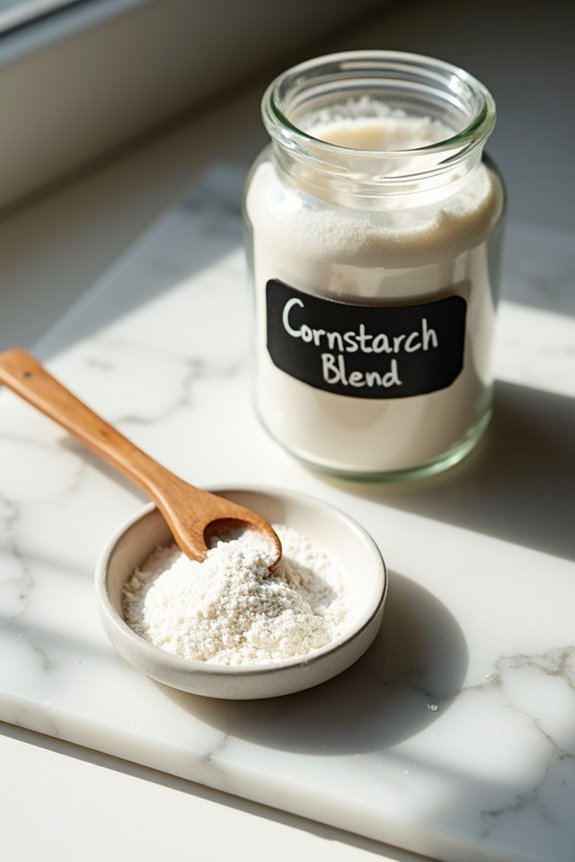
If you’ve mixed up a batch of homemade cornstarch baking powder blend, you’ll want to store it properly so it works when you need it. Moisture and heat will degrade the mixture.
Here’s what works for storage:
- Store in an airtight container at room temperature away from sunlight
- Label containers with the mix ratio and date so you know what you’re using
- Keep blends away from humidity, which causes clumping and reduces leavening power
- Check for sour odors or discoloration before using
Your homemade baking powder blend stays potent for three to six months, depending on conditions. Once you notice any funky smells or color changes, discard it and make a fresh batch. Proper storage means your cornstarch substitute performs when you need it for baking.
When Cornstarch Works (and When It Doesn’t)
You’re probably wondering: can cornstarch really replace baking powder in your favorite cake recipe? Here’s the honest truth: cornstarch alone won’t give you that fluffy, risen texture you’re after. I’ve learned this the hard way. Cornstarch doesn’t create leavening—it won’t generate the carbon dioxide bubbles that make cakes light and airy. Instead, it acts as a thickener. Use cornstarch solo, and you’ll end up with something dense and flat. Where cornstarch actually shines is in DIY baking powder blends. Combined with baking soda and an acid, it stabilizes the mixture and helps ingredients distribute evenly. Think of it as the supporting player, not the star. For best results, pair cornstarch with other leavening agents rather than relying on it alone.
Your Cornstarch Blend Didn’t Work? Here’s Why
When your cornstarch substitute turns out dense, flat, or crumbly, there’s usually a culprit—and it’s almost always an imbalance in your blend.
Real baking powder contains both acid and base working together to create CO2 gas. Your cornstarch blend likely missed this essential chemistry. Here’s what probably went wrong:
- You skipped the acid (like cream of tartar or lemon juice)
- You forgot to include baking soda as your base
- You didn’t measure ingredients accurately
- The ratio between acid and base was off
Test your blend with a simple trick: mix half a teaspoon with warm water. No fizz? That’s your answer—it’s not generating the gas your baked goods need to rise. Cornstarch alone is just a thickener, remember. You need both components working together to replace baking powder’s leavening power.
Making the Switch: Your First Cornstarch Substitute Recipe
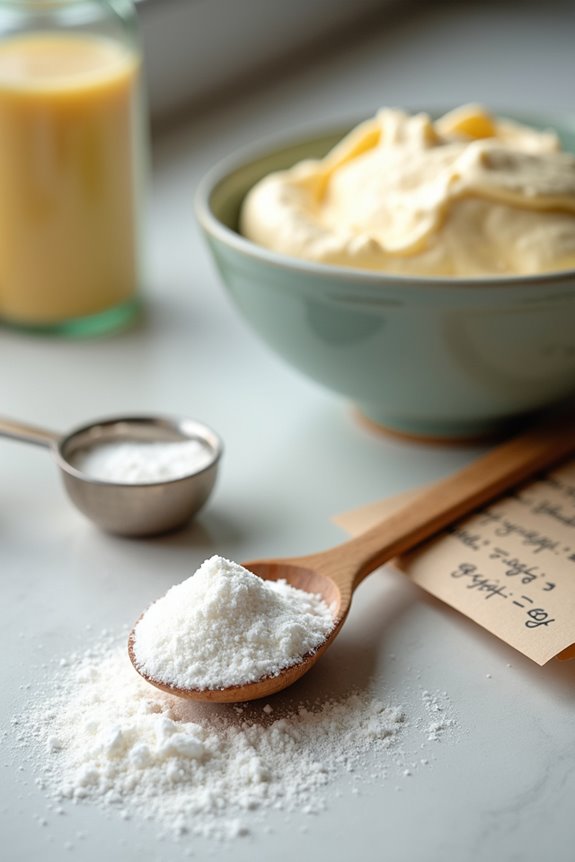
Ready to actually make this work? Let me walk you through my go-to cornstarch baking powder substitute recipe. I combine 1/2 teaspoon cream of tartar, 1/4 teaspoon cornstarch, and 1/4 teaspoon baking soda to replace one teaspoon of baking powder. That cornstarch helps prevent clumping, keeping everything evenly distributed in your batter.
Here’s what I do: I measure each ingredient carefully into a small bowl, then whisk them together thoroughly. The cornstarch prevents those annoying lumps that wreck recipes. For larger batches, I scale everything proportionally—doubling or tripling the amounts depending on how many teaspoons I need.
Store your mixture in an airtight container at room temperature. You have a reliable baking powder substitute that works.